All UK road signs are made using a palette of just ten basic colours – though three of them are quite rare, and only seven make up the majority of our signs.
Each colour has meaning, and its meaning can vary depending on the context. Explained below are the places you’ll find those colours, and what they mean in each case.
Red
Red is one of the commonest colours on UK road signs, and on warning signs it signifies danger. Triangular warning signs have thick red borders.
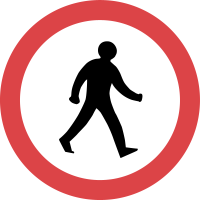
On circular regulatory signs, red circles indicate a prohibition. Some include a red symbol to highlight the prohibited action.



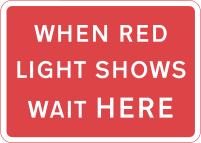
Rectangular information signs with a red background indicate special temporary instructions.

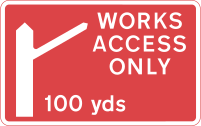
Elsewhere, red can be used on some rarer types of direction sign. Directions on a red background are used for works traffic within areas of roadworks. Directions on a white background with a red border are for military sites.

The colour is equivalent to BS 381C “Signal Red”.
Yellow
Yellow is mostly used to draw attention. On regulatory signs, a yellow background often indicates restrictions on parking, waiting or loading.


Direction signs with a yellow background are temporary directions or diversions and might replace permanent signs while roadworks are ongoing. A yellow background can also be used at checkpoints and weighbridges.
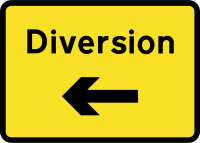
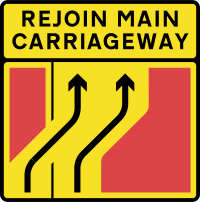
The colour should match BS 381C “Lemon”.
Blue
Blue is mostly used to indicate a positive instruction or to relate information. It is also associated with parking.
Circular regulatory signs use blue backgrounds to give mandatory instructions or to show exclusive use of the road by specific vehicles.
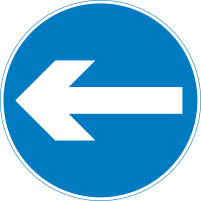

On direction signs, blue is used for motorways. However, blue is also used away from the motorway network for signs for non-motorised road users.

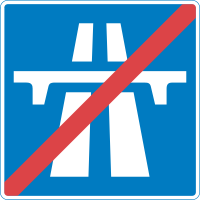

Many general information signs have blue backgrounds, largely to differentiate them from direction signs and warnings. On parking signs, a blue background is used to show parking places, and crossed out to ban parking and stopping.
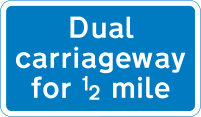

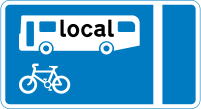
The colour should match BS 381C “Middle Blue”.
Dark green
Dark green is not used on warning or regulatory signs. It appears as a background colour on direction signs for primary routes. Primary route signs also use yellow for route numbers.


The colour is equivalent to BS 381C “Middle Brunswick Green”.
White
White appears on many signs, often simply as a clear background so that other symbols and colours stand out clearly. However, it has special meaning on some parking, loading and waiting signs where it indicates instructions for the use of marked bays.
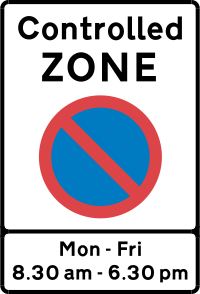

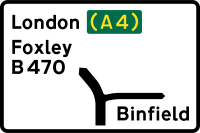
On direction signs, a white background with a black border indicates directions for a non-primary route – the lowest and least important type of road. Red bordered military signs (above) also have a white background.

Black
Black is obviously used for text and symbols on many signs, where it’s used for clarity and has no particular meaning. But there’s a category of direction signs with black backgrounds, which are used for heavy goods vehicles. Black HGV signs should always include a lorry symbol to make it clear who they are intended for.

A small panel with a black background on direction signs indicates a junction number.
Brown
Brown is limited to direction signs, where it indicates signs for tourist destinations. Tourist signs almost always include a symbol relating to the attraction.

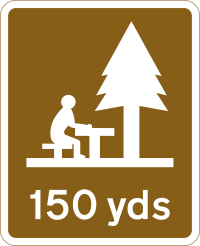
The colour should match BS 381C “Middle Brown”.
Light green
A much brighter green colour is used on a very small number of signs, including Quiet Lane signs and directions for emergency services at large venues or complex sites.

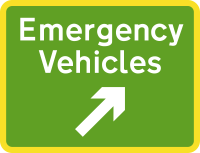
The colour is equivalent to BS 381C “Light Brunswick Green”.
Orange
Orange is almost never used on actual sign faces, but the colour is specified for the housing of emergency telephones, and so it also appears on road signs pointing to them.

The colour is equivalent to BS 381C “Light Orange”.
Grey
Grey is only used in a very limited number of places on signs, including the end of bans and restrictions and in the background of some weight restriction signs.
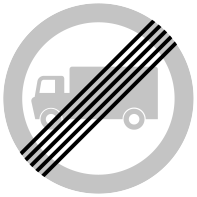
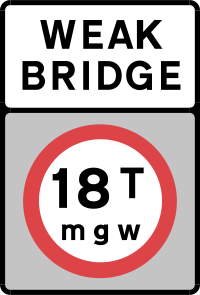
The colour should match BS 381C “Aircraft Grey”.